Lower fish catches are pushing Thai boats farther offshore and, in some cases, across borders, where Myanmar migrant fishermen can be left without protection for their rights
Ranong Province, THAILAND – A Thai trawler carrying Ko Myat Aung, a 35-year-old migrant worker and eight other crew members, has recently been traveling farther offshore, secretly crossing into Myanmar’s territorial waters frequently despite the risk of arrest for illegally entering and fishing without authorization.
Originally from Myanmar’s Dawei, Ko Myat Aung moved to Ranong province several years ago in search of better economic opportunities. The province’s fishing industry relies heavily on migrant workers from Myanmar.
But breaking the law was never part of his plan.
His recent trip took him near Zadetkyi Island, also known as Saint Matthew’s Island, at the southern end of the Mergui Archipelago – not far from where a Myanmar Navy ship opened fire on a Thai trawler named Sor Charoenchai 8 as it entered Myanmar waters in November 2024.
The incident led to the arrest and imprisonment of 31 crew members. Twenty-seven of those arrested were from Myanmar, while the remaining four were Thai nationals.
Although Ko Myat Aung and the other crew members returned safely to shore, there is no guarantee they will be as fortunate on their next trip.
“The scarcity of catches in Thai waters, strict fishing regulations and the ban on fishing near coastal islands have pushed boats to venture into Myanmar’s territorial waters,” he said.
Thailand began reforming its fishing industry after the European Union issued the country a yellow card in April 2015, warning it could face an import ban on fisheries products if it failed to address illegal, unreported and unregulated (IUU) fishing.
In response, the Thai government introduced stricter fisheries laws and enforcement measures, including the Fisheries Act 2015, tighter controls on fishing gear, mandatory vessel monitoring and catch reporting, and a port-in, port-out system to track fishing vessels.
The government also introduced measures to regulate the employment of migrants, who account for nearly 90% of the 60,000 workers in Thailand’s commercial fishing industry, mainly from Myanmar and Cambodia. The measures also aim to strengthen protections against forced labor and human trafficking.
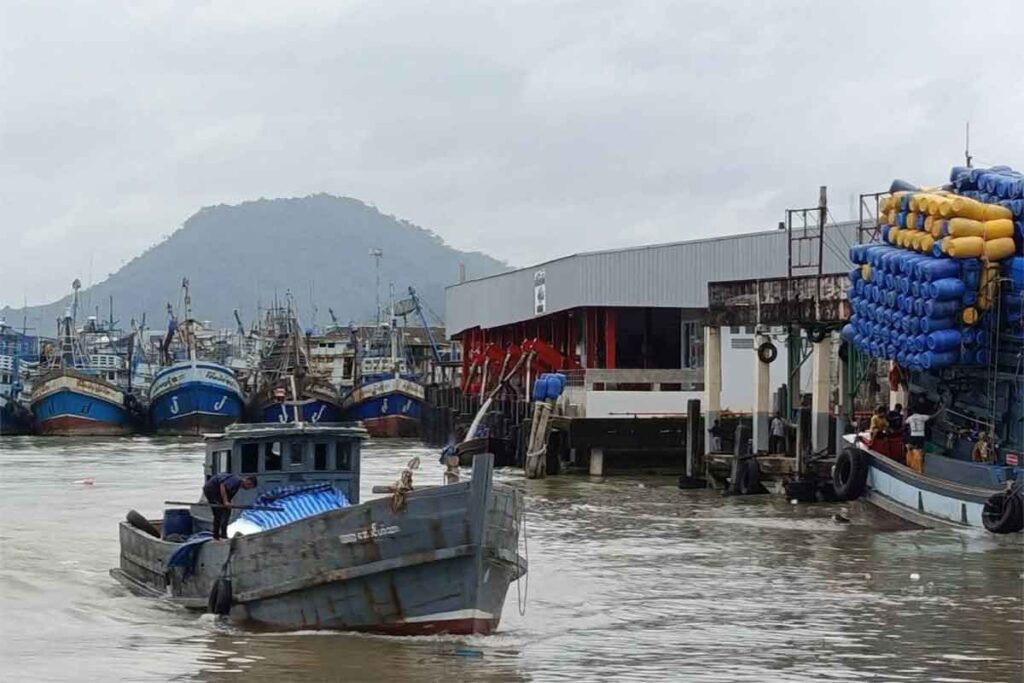
Though these efforts have improved traceability and strengthened protections for migrant workers, decades of overfishing and widespread destructive fishing practices have left fish stocks severely depleted.
According to the Food and Agriculture Organization (FAO), Thailand’s marine capture fisheries have been on a downward trend, falling to 1.3 million tons in 2022, from a peak of 2.8 million in 1998. Despite this decline, the country was the world’s ninth-largest exporter of fish and fishery products, with exports worth US$5.6 billion in 2024.
A report by the Environmental Justice Foundation found that depleted fish stocks were forcing vessels to stay at sea longer and travel farther in search of catches, increasing the risk of human rights abuses and human trafficking as operators seek to cut costs amid declining returns.
That pressure was evident in Ko Myat Aung’s experience. As catches become harder to find, migrant fishing workers face longer hours at sea, exhaustion and the added risk of arrest or confrontation with naval forces when boats venture into foreign waters.
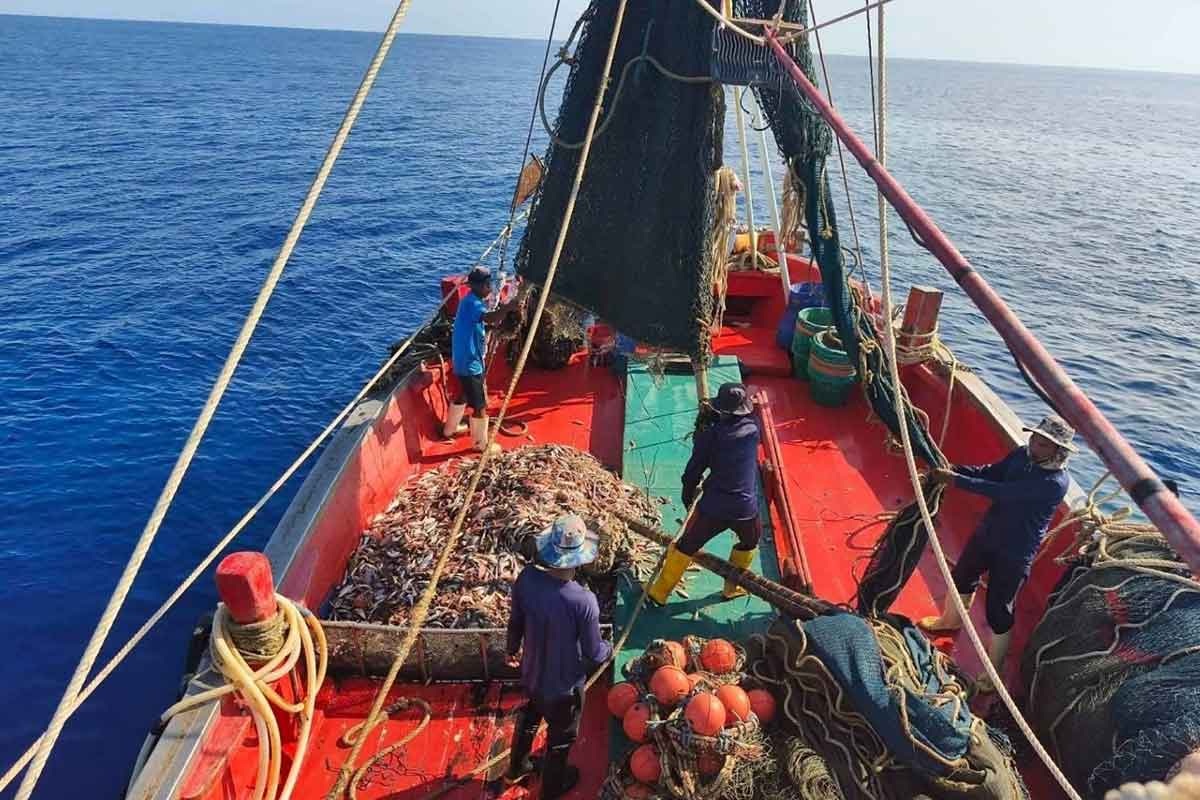
“We get an hour or two for rest between hauls,” Ko Myat Aung said, adding that the crew casts the net four times a day, with each haul followed by hours of sorting the catch. “But if the net tears, there is no rest at all. We just go from one haul straight into the next.”
The trawler he worked on used bottom-trawling gear, lowering nets to the seabed and dragging them across the ocean floor. The nets frequently snagged on rocks and coral reefs and tore, he said.
Fishing without rest
Long working hours to maximize a catch are a common experience among Myanmar migrant workers.
Under Thai law, migrant workers are generally entitled to a standard eight-hour workday and one day of rest per week. They are also entitled to annual leave, including sick leave, public holidays and personal leave, as well as access to health insurance.
Thailand became the first country in Asia to ratify the Work in Fishing Convention, 2007 (No. 188) in 2019, which protects the living and working conditions of people working aboard fishing vessels.
“Out at sea, those protections don’t exist for many workers. They do as the skipper says,” said Ko Zaw, a 46-year-old fisherman with 25 years of experience who comes from Dawei and lives in Ranong province.
He said skippers, who receive a share of the catch, have an incentive to maximize the haul. As a result, dragging nets across the seabed and working without adequate rest have become common practices.
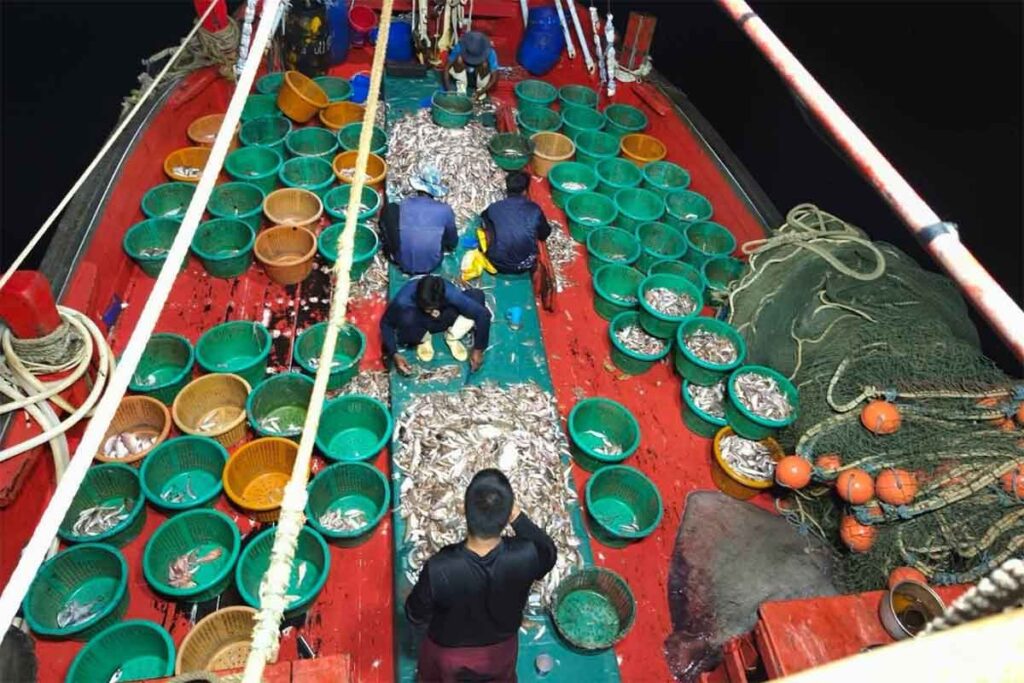
Despite fishermen’s rights being reflected in several instruments and conventions, Nattawut Kasem, a campaigner with the Environmental Justice Foundation (EJF) Thailand, said the implementation gaps remain large.
He cited an EJF survey of 132 fishermen working on 50 vessels in 2024-2025 that found 95% worked excessive hours, 97% had their identity documents withheld and 82% lived in poor conditions. The number of incidents on the ground is likely substantially higher than those reported to NGOs or government hotlines.
“Fishing remains one of the most dangerous and least protected jobs in Thailand. Long hours, isolation and weak oversight mean that even today, many fishermen still lack access to fair pay, safety protections or medical compensation when accidents occur,” said Nattawut.
“When violations happen, many stay silent because they fear losing their jobs or being blacklisted. Without protection for whistle-blowers, justice remains out of reach for the most vulnerable. Behind every unreported case of abuse is a fisherman who didn’t feel safe to speak up – and that’s where the real gap between law and reality lies.”
Those protections can disappear entirely when fishing vessels carrying Myanmar migrants cross into foreign waters beyond Thailand’s jurisdiction, where the workers may instead be treated as criminals.
In the case of the Sor Charoenchai 8, a Thai fishing boat fired on and detained by the Myanmar Navy, the four Thai crew members were released under an amnesty three months after their imprisonment following negotiations between the Thai and Myanmar governments.
The 27 Myanmar fishermen, however, were not released until April 2026, nearly one and a half year later, after serving penalties imposed by Myanmar courts.
No legal aid was provided to their families during their imprisonment. Ma Khaing Zin, whose family member was among those detained, said: “We are struggling on our own with two children.”
A chance of no return
In the early hours of October 29, 2024, Ko Kyawt Kee, a father of two from Myo Haung village in Launglon Township in Myanmar’s Tanintharyi Region, disappeared after leaving a rented house in Ranong to work on a light boat. This fishing vessel uses high-intensity lights to attract and lure fish or squid to the water’s surface.
By 2pm, his colleagues called his wife, Ma Zin, to tell her that he had fallen overboard and died. The boat returned to shore 11 days later and continued its operations. His employer never contacted her.
She searched along the coast for a week, hoping to find his body. Eventually, she gave up and held a merit-making ceremony for him according to Buddhist tradition.
“The body has never been found. I can’t even get an answer as to why he died,” Ma Zin said, weeping.
Thai police reported that 306 migrant fishermen were classified as dead or missing at sea between 2020 and 2022.
Thai law requires fishing vessels involved in an accident to provide first aid, alert the authorities and return to shore immediately. Port-In Port-Out authorities are also responsible for collecting evidence and investigating incidents. But the cases have rarely been reported because of migrants’ limited access to relevant information and aid.
Ko Myat Aung decided to quit fishing recently because he feared being arrested while working in Myanmar waters. The risks were not shared equally between Thai skippers and Myanmar crew members, he said.
“If something happens, the Thai skipper gets bailed out, but we Myanmar crew members are the ones who suffer. It’s not a fair trade for our lives. We don’t have the power to tell them [the skippers] to stop doing this.”
This story was supported by Internews’ Earth Journalism Network and reported in collaboration with Mekong Eye and Dawei Watch.