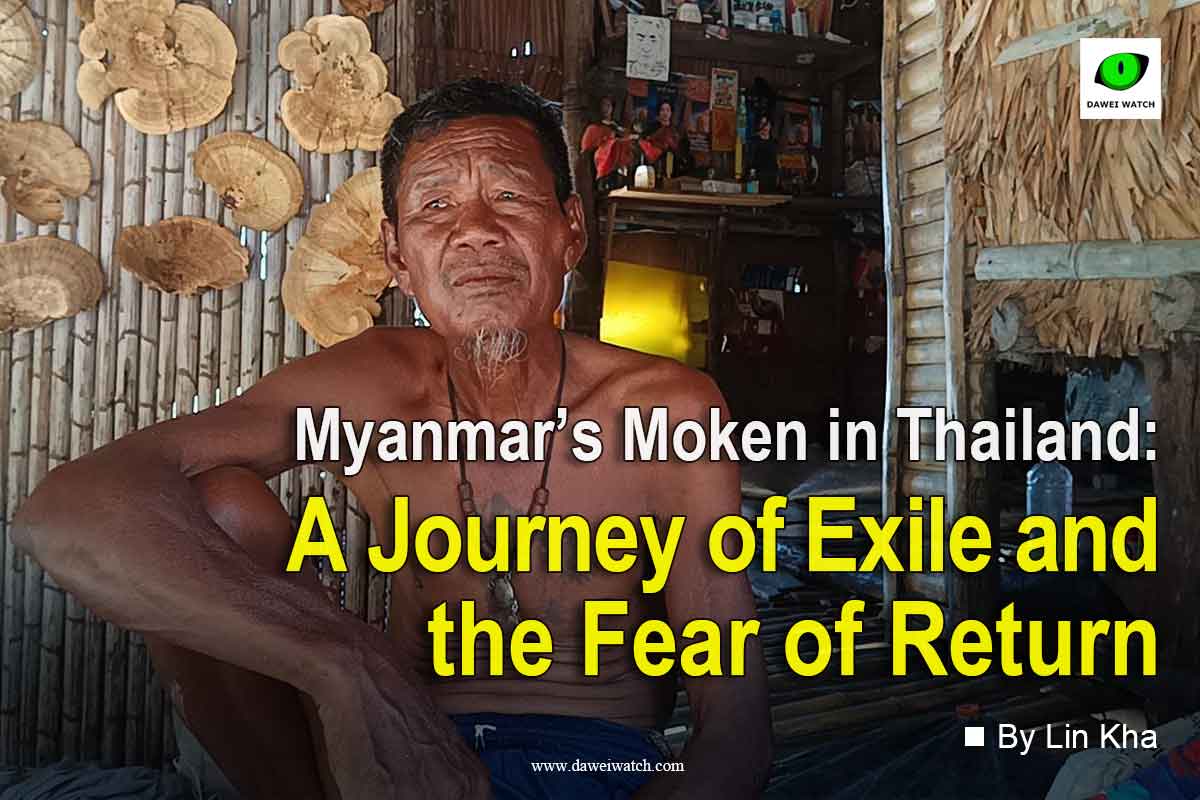
Tet is meticulously finishing a hand-carved wooden boat about a cubit long. Once completed, this small vessel can be sold for 1,500 Baht. Having done this for decades, he can finish a boat in three days without mistake or hesitation. These small traditional Moken boats are the signature handmade product of the island where he lives.
It is not just a means of livelihood for the Moken; it is a traditional ancestral heritage that serves as a home for these sea dwellers. This small boat is an exact replica of the traditional six-fathom-long rowing boats. On this island, no one except Tet—an elder of the people known as ‘Sea Gypsies’—knows how to carve these traditional replicas anymore.
The island where he currently resides is Surin Island (Koh Surin Tai) in Thailand, which sees hundreds of tourists daily. Surin Island is located in the sea west of the Myanmar-Thai border towns of Kawthaung and Ranong; it is the southernmost small island in the chain visible from the coast. The largest island in that group is Zadetkyi Island, which belongs to Myanmar. Surin Island, however, is a Thai border island and the furthest from the Thai mainland.
About 400 Moken live on this island, including the oldest elder, Tet. In other words, more than one-fifth of the entire Moken ethnic population lives on this Thai-owned island. Including those like Tet who were born in the Myeik Archipelago, the entire Moken ethnic population now numbers only about 1,800.
Tet (also known as Atet), a father of 11 children, is now well-settled here. He no longer lives the nomadic ‘Sea Gypsy’ life, wandering from island to island. It has been a decade since he stopped diving, fishing, squinting for squid, or gathering shells. Currently, his work consists of carving traditional Moken wooden figures—boats, people, and fish—for tourists to study and purchase. This has become his most practiced skill.
The income from his small handmade craft shop in front of his house is sufficient for him and his family. Surin Island is the safest place he has ever known in his life. The Thai government looks after him and his people well, providing a life guarantee that allows them to live with human dignity.
“The Thais trust the Moken. If we get sick, they take us to the hospital and provide treatment. We don’t have to pay for that; we only pay for the food we buy for ourselves,” Tet says calmly. He has a smart card issued by the Thai government. The header of the card reads in Thai: “Registration Card for Persons Without Registration.” The name on the card is Tet.
Issued in June 2018 under the signature of the Director of the Registration Office in Khura Buri, Phang Nga Province, the expiration date on the card reads: “Lifetime.”
“The Thai soldiers don’t bully us. Even now, look, they [Moken] keep coming to the island one after another. Even if there is no place to stay, they are still allowed to stay,” Tet says.
His birth year is listed as 2496 (Buddhist Era) on the card. According to the registration, he is 72 years old, though he may be older. With his copper-colored skin, the elder Tet remains strong and healthy, save for a slight stoop when he walks. He has decided to end his final days here on this Thai-Moken island where his ancestors are buried.
He remembers his birthplace well. However, because those memories are intertwined with heartbreak and bitterness, he no longer wishes to return.
“I don’t want to go, and I don’t want to return. I’m afraid the [Myanmar] soldiers will bully me,” Tet says, casting his eyes down. His eyes are misty beneath his lids. His childhood memories in the Myeik Archipelago are a mix of freedom and joy, combined with oppression, insults, and life-threatening dangers. Like the tides of the sea where he grew up, his life has seen many highs and lows.
As he speaks, his trembling hands seem not to have forgotten the bravery of his youth when he held a Moken fishing harpoon. On Owen Island (also known as Pearl Island) in the middle of the Myeik Archipelago where he was born, he and other Moken teenagers were masters of the harpoon.
With little greed and a culture of searching only for daily survival, their birth island was like a ‘Padaythar Pin’ (a mythical tree of plenty) that provided inexhaustible sustenance. The islanders could never finish the wild edible plants, fruits, and greens. For meals, fish, squid, shells, and crabs could be gathered just by taking a small rowing boat along the shore for a few moments.
They could collect decorative shells to exchange at larger villages on other islands for rice, oil, medicine, and salt. If parents found valuable natural pearls while diving, they would save them and sell them in Myeik; they would return with small, wondrous gifts from the city, which was a source of great joy.
That joy was shattered by the arrival of armed strangers who spoke Burmese. These strangers (including Myanmar soldiers) claimed they would farm pearls and seized the calm bays where the Moken fished. Entry to those areas was strictly prohibited. The current residents were evicted from the beaches they occupied.
“We were dragged out of our houses. We weren’t allowed to take any belongings,” Tet says.
The Moken tribe faced great hardship. They were no longer allowed to live on the smooth beaches with fresh water that were suitable for habitation, nor were they allowed to roam the bays where they could safely find fish and shells. Meanwhile, the strangers accused them of being thieves and tortured them. They framed the Moken by claiming they found fishing spears in the baskets where the strangers farmed pearls. The honest, simple tribe felt a deep, piercing bitterness.
“We didn’t steal. Theirs are ‘fake’ pearls; why would we steal them?” Tet says, his voice tinged with pride. The Moken consider pearls created by inserting a bead into an oyster to be “fake.” Even natural pearls found in oysters were things they never stole from one another.
No matter how much the Moken explained, the strangers—who were determined to drive them off the island—set fire to their homes. “They poured gasoline and lit them up,” Tet says, mimicking the action of striking a match and throwing it.
For the Moken of Owen Island, there was no choice but to leave their birthplace. “Let’s move far away from the strangers,” they decided. Families without large boats were taken aboard larger Moken vessels. Small rowing boats were towed in a line behind the larger ones as they abandoned the island. They steered their bows toward the faint islands visible across the deep sea, in the opposite direction from where the strangers had come.
“We lived only in the boats. We would rest at an island for a day or two, and then keep going… keep going.” Tet’s eyes reflect the difficulties and the sense of inferiority they felt during that journey.
Some Moken in the group stayed behind at islands with clear water, and the group gradually split up. His family, led by his grandfather, reached Lampi in Kawthaung District and established a home there. From there, they extended their travels toward Zadetkyi Island. However, the soldiers and strangers reached those islands as well.
When Tet was a young man, his family and some other Moken reached their current island while wandering and settled here. They did not know which government owned the island; they only knew it as an uninhabited place. “There were no people here. We built about seven houses and began living here,” Tet says. This was the beginning of the Moken village on Surin Island.
Tet met a Moken girl named Sabai on this island. After they married and had two sons, Thai people arrived on the island. Thai authorities told them to leave. However, they were gentle and not rude like the Myanmar soldiers. The Moken pleaded their case.
“We have nowhere else to go. We have been here for a long time. If you evict us, we would rather die here,” they said, risking everything to stay.
The Thais asked for proof that they had lived there for a long time. They showed the authorities their ancestors’ burial grounds. When told that wasn’t enough, they showed sites on the high parts of the island’s mountains where battles had once taken place (Tet mentions there were bunker pits and pottery from old battles on the mountain). The Thais were satisfied and allowed them to continue living there.
Today, there are more than 80 Moken households on the island. Tet, who arrived as a teenager, has become “Mr. Tet,” the oldest elder on the island. Thai authorities treat him with respect and occasionally take him to different parts of Thailand. Tourists, boat owners, and anthropologists who visit the island also treat him with great respect.
Though he has had chances to return to the islands in Myanmar over the years, he has never gone. Even when relatives died on the nearby islands of Zadetkyi or Nyaung Wee, he did not go.
“In my heart, I want to go. I didn’t even dare go when my sister and brother died. My relatives even sent word asking, ‘Grandfather, please come.’ I didn’t dare go because I was afraid,” Tet says.
It goes without saying what he fears: he cannot face meeting the Myanmar military again. “Myanmar soldiers bully people” has become Tet’s constant refrain.
He knows as much as he needs to about the current situation in Myanmar, hearing it from Moken who come from the islands there. He says he is aware that the Myanmar military is worse than before. Therefore, his decision to be buried on this island will not change.
However, Tet confesses that before he dies, he still wants to visit his relatives on the Myanmar islands one last time. He says that on the day he can believe the military can no longer bully him, he wants to return to his birthplace for a short visit.
“I haven’t reached Nyaung Wee and Jalan since I grew old. If the village becomes peaceful, I want to go and see it.”
By Lin Kha