High School Students by Day, Militiamen by Night
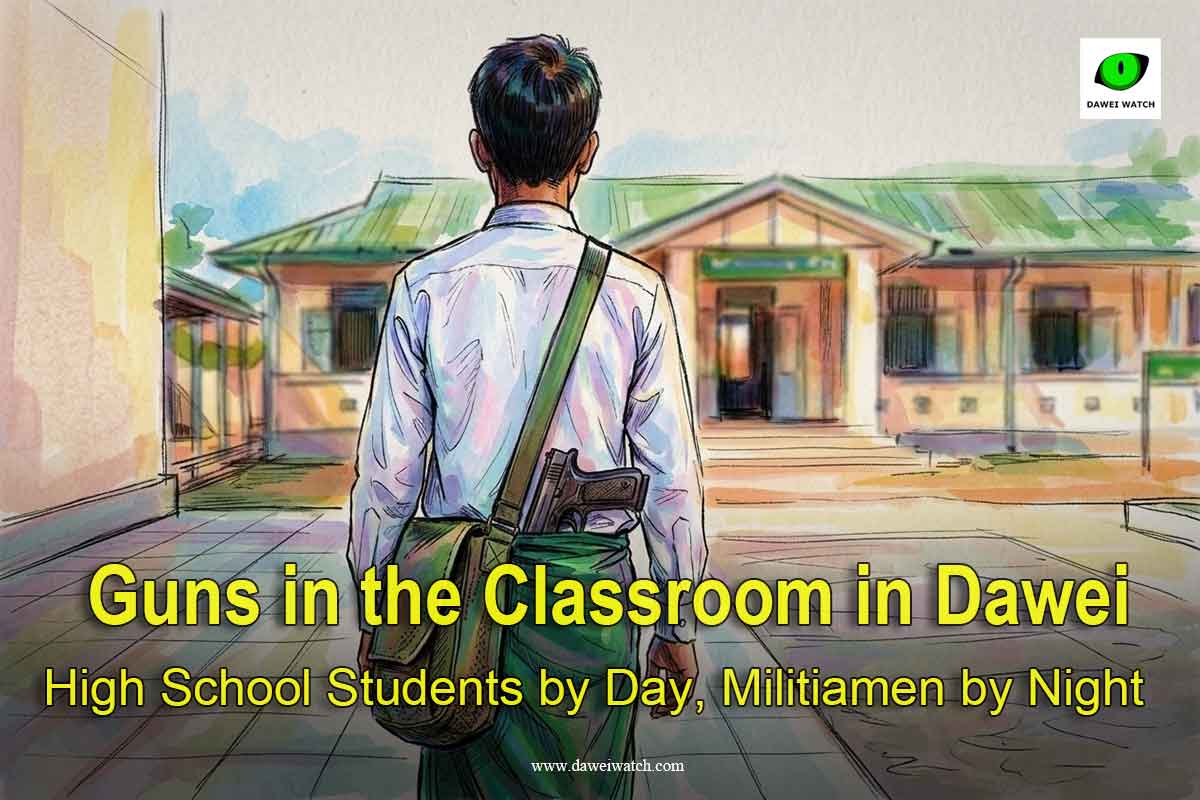
Scenes typically reserved for action movies can now be witnessed inside high schools in Dawei. In front of a restroom at a local high school, a student dressed in the traditional white-and-green uniform points a gun at a classmate, forcing him to kneel and apologize.
According to Maung Phyo (a pseudonym), this is the grim reality that has emerged in Dawei’s schools over the four years since the military coup. He has experienced it firsthand.
Maung Phyo moved to the city in 2025, seeking refuge from the instability of his home village to continue his education. However, the school in the city did not prove to be the safe haven he had imagined.
“They borrow money from us and never pay it back. When we ask for it and an argument starts, they take us to the school toilets and point a gun at us. Then they make us kneel and apologize,” Maung Phyo recalls his experience of being bullied.
Maung Phyo is a Grade 5 student at High School No. 6 in the Myaung Pulae ward of Dawei. At 14 years old, he should normally be in Grade 8, but his education was delayed by three years following the coup; he was only able to resume his studies in the city in 2025.
On February 22, while traveling from Dawei back to his native village, Maung Phyo was detained by a revolutionary group. An official from the group explained that they held him after finding photos on his phone showing him in a militia uniform, armed and traveling in a vehicle with other militiamen.
Dawei Watch was granted an interview with Maung Phyo while investigating reports of armed students.
Guns in the Classroom
Two Grade 10 students, including a boy named Min Wanna Kyaw, also moved from rural areas to attend the same high school in Myaung Pulae, Dawei. Unlike typical students, however, they reportedly carry pistols in their school bags every day.
“When they come to school, they have guns tucked inside their bags,” Maung Phyo explains.
For Maung Phyo, seeing a handgun instead of a pencil sharpener in a classmate’s bag was like a nightmare. After being threatened with that gun once, he never dared to argue with them again. Being schoolmates of a similar age, Maung Phyo eventually became an associate of Min Wanna Kyaw’s circle.
Maung Phyo claims that armed students can be found in almost every major high school and private school in Dawei, including High School No. 1 and No. 2 in Dawei city. A parent of a middle school student in the Myothit ward confirmed these reports.
“I have to constantly warn my children,” the mother said. “I tell them to be careful if they associate with those students and never to follow them if they are called away.”
These armed students do not only bully their peers; they are also known to threaten teachers. When contacted by Dawei Watch, an official from the Tanintharyi Region Education Office did not issue a flat denial. The official stated that while they have heard rumors of students carrying guns and threatening others, they have not been able to confirm it officially, as no formal complaints have been filed.
“We’ve heard whispers—hints that such children exist,” the education official said. “We have instructed teachers to remain vigilant regarding this matter.”
Part-Time Militiamen
Dawei Watch’s investigation revealed that these armed students are members of the Pyu Saw Htee or People’s Militia, groups backed and armed by the military junta. Following the coup, these militias appeared throughout Tanintharyi Region. Initially, they were comprised of veterans, members of the ultra-nationalist Ma Ba Tha, supporters of the USDP party, and pro-military adults.
Over time, however, minors began appearing in their ranks. This trend accelerated particularly after April 2024, when the military activated the National Conscription Law.
“Many of the Pyu Saw Htee causing trouble in the city now are only 18, 19, or 20 years old. They were just children when the coup happened in 2021,” said a 35-year-old Dawei resident.
In Dawei, there is a group known as the “Native People’s Militia (Dawei).” Students like Min Wanna Kyaw from High School No. 6 are members of this group—serving as students by day and militiamen by night.
By arming minors and involving them in conflict, the regime is actively violating the UN Convention on the Rights of the Child, to which Myanmar is a signatory. Critics argue the military junta is blatantly sacrificing the future of these children to maintain its grip on power.
While the Tanintharyi regional education official promised to investigate whether students are involved in militias, Dawei Watch’s interviewees suggest these teenagers are already performing duties such as patrolling the city, guarding checkpoints on the outskirts, and providing security for junta officials. The 35-year-old resident mentioned frequently seeing high school-aged militiamen providing security for the Tanintharyi Chief Minister, U Myat Ko, during his city tours.
“They act like they are SWAT teams protecting a president,” the resident added, describing the masked, uniformed teenagers.
The “ASEAN” Raid
In late 2025, Maung Phyo was involved in an unexpected incident. While he and four friends were at a billiard hall on a school holiday, Min Wanna Kyaw arrived. He demanded that Maung Phyo’s group show him the locations of shops illegally selling “ASEAN”. ASEAN is a local slang term for kratom or related substances; a tropical leaf used as a stimulant or sedative. Often sold as a brewed ‘syrup’ or tea, it has become the primary substance of choice in the Dawei and Southern Thailand area due to its low cost and high availability.
Instead of a simple tour, the group was taken to the Township General Administration Office near Madyland Hospital—which serves as a headquarters for the Native People’s Militia.
Upon arrival, the five friends were forced to put on militia uniforms and were each issued a G3 rifle. Led by Min Wanna Kyaw and guided by Maung Phyo, the group—looking like a formal patrol—raided a shop near the Than Bridge in Kyet Sar Pyin ward.
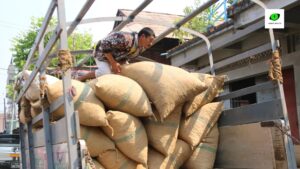
“We stood guard outside. Min Wanna Kyaw went inside and seized the goods in sacks. He didn’t arrest the owner but extorted 300,000 Kyats from him,” Maung Phyo recalled. Of the seven people in the group, only the driver was an adult; the rest were student-militiamen.
Students, Drugs, and the Militia
While these militias claim to ‘crack down’ on drugs and ASEAN, they are often victims of addiction themselves. Maung Phyo reported that the young militiamen frequently use “WY” (methamphetamine) pills. Though they avoid use during school hours, they reportedly consume them during holidays.
According to Maung Phyo, his militia “friends” often travel to nearby villages like Min Yat, which is around 7 miles away from Dawei city, in civilian clothes, returning with WY pills and kratom leaves. Maung Phyo himself admits to being a user of “ASEAN” (kratom), which is how he knew the locations of the shops.
However, the most common substance among high schoolers is the E-cigarette (vape), which is easily accessible and affordable. A teacher in Dawei confirmed that while “WY” use is hidden, E-cigarettes are frequently confiscated in classrooms.
For these teenagers, joining the militia is seen as a ‘gold mine.’ They receive a stipend from the military and can extort money from illegal shops, providing them with the cash needed to buy drugs.
From Pens to Guns
The rise of student-militiamen coincides with the activation of the Conscription Law in April 2024. Joining the local militia allows youth to avoid being forcibly drafted into the regular army, where they would be sent to the front lines after training.
In the local militia, they stay in their own town. They enjoy perks such as riding motorcycles without helmets and wandering the streets at night during curfew without fear. For children from impoverished backgrounds with no job prospects, the militia offers an easy path to money and perceived ‘power.’
The military junta has effectively traded the pens in these children’s hands for guns. To ensure its own survival, the regime has shown no hesitation in using students like Maung Phyo as pawns.
As one Dawei schoolteacher put it: “These children are not to blame. They are being manipulated by financial incentives and drugs. They need to be corrected and guided. Whether intentionally or not, we cannot allow our children to become tools of war.”